Laminate and LVP flooring installation in Apex, NC
Click-lock vinyl plank and laminate installed room by room — old carpet out, subfloor sorted, transitions and trim finished properly.
- Luxury vinyl plank and click-lock laminate
- Old carpet, pad and tack strip removed and hauled off
- Squeaky subfloors fixed before the new floor goes down
- Transitions, thresholds and stair nosing
- Shoe molding or quarter round to finish
Covering Apex · Cary · Morrisville · Durham
Book flooring installation
Done right the first time
The job gets sized up properly, the right materials get used, and it holds up after we leave.
Experienced handymen
Work goes to people who do that trade every week — not whoever happens to be free.
Honest work and pricing
Describe the job on the phone and get a realistic number before anyone comes out.
Why choose us
Your trusted home repair partner
We make home maintenance simple and reliable. Whether it is a quick fix or a bigger project, one call gets it handled.
- Trusted expertise
- Customer-first approach
- Reliable service
- Fair, upfront pricing
- Safety and care
- Local and friendly
The subfloor decides how the floor turns out
A floating floor follows whatever is beneath it. Any dip or hump greater than about three-sixteenths of an inch over ten feet will telegraph through, and on a click-lock product an unsupported spot puts stress on the joint until it separates and starts to click underfoot. Getting the subfloor flat is the difference between a floor that stays tight and one that develops problems in the second year.
Most houses in this area are one of two constructions. Newer builds across Apex, Cary and Morrisville are generally plywood or OSB over joists, sometimes on a slab at the first floor of a townhome. Older houses, particularly in Durham, are plank or plywood over a crawlspace. Each needs a different check.
Crawlspace houses need the moisture situation understood before anything goes down. If the crawlspace has no vapor barrier or has standing water after rain — which is common in Piedmont clay, where water sits rather than drains — moisture moves up through the subfloor into the new flooring. That is a waterproofing problem, and putting a floor over it just hides it for a year.
Slabs need a moisture test and the right underlayment with a vapor retarder. Concrete releases moisture for a long time, and a slab that reads dry to the touch can still be well above the limit for a glued or floating floor.
Squeaks, and the moment to fix them
The one opportunity that gets missed is the window between the old floor coming up and the new one going down. With the subfloor exposed, squeaks are trivially fixable — the squeak is the subfloor moving against a joist or a shank nail, and screwing the panel down into the joists eliminates it in minutes. Once the new floor covers it, that same fix means pulling the new floor back up. Always worth spending the extra half hour.
Carpet out, plank in
Carpet removal is straightforward and messy: the carpet gets cut into manageable strips, the pad comes up, the tack strip and staples are pulled, and everything gets hauled away. Wake County and Durham both restrict what can go in normal collection, so it goes to a proper disposal site.
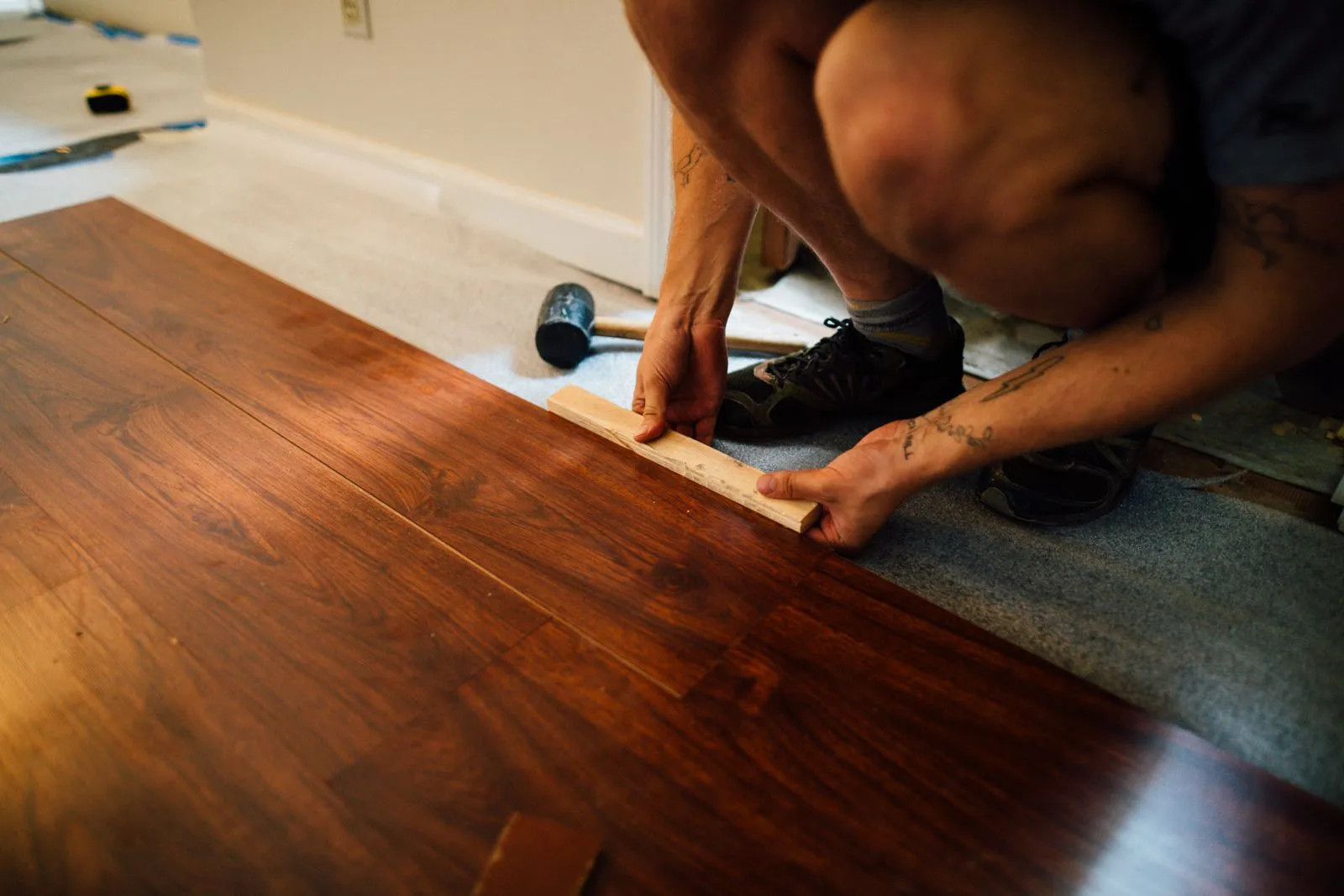
The plank layout is where the craft shows. Boards are racked out of several boxes at once so the color variation blends rather than showing as a batch stripe. End joints are staggered, and no piece under about eight inches should end up at the start or end of a row. The expansion gap around the perimeter — a quarter inch or so, hidden by the shoe molding — is not optional. A floating floor expands and contracts with the seasons, and one butted tight to the walls in a humid August has nowhere to go but up.
Door casings get undercut so the plank slides beneath them, which looks finished; notching the plank around the casing does not. Doors that now clear a thicker floor may need trimming at the bottom, and interior doors sometimes have to be re-hung slightly.
Transitions, stairs and trim
Every doorway to a room that is not getting the new floor needs a transition strip matched to the height difference. Every closet and every hearth is another edge to finish. This detailing is a real share of the labor and it is what separates a finished-looking room from an obviously DIY one.
Stairs are their own job. Each tread needs a nosing piece cut and glued, risers get faced, and nothing is square in a staircase. Anyone pricing a whole-house floor should expect stairs to be quoted separately.
New flooring is the natural moment for interior painting, since baseboards come off anyway, and for furniture assembly if new pieces are arriving with the new room.
Flooring installation — common questions
Can the new floor go over what is there now?
Over vinyl sheet or well-bonded tile, often yes, provided the surface is flat and sound. Never over carpet. Going over an existing floor raises the height, which then has to be dealt with at doorways and at the transition to any adjoining room, so it is a judgment call rather than an automatic yes.
Do you move the furniture?
Yes, for normal household furniture within the same house. Emptying a room into an adjacent one is part of the job. Pianos, gun safes, aquariums and anything needing specialist equipment are the exceptions and should be arranged separately.
How long does a room take?
An average bedroom with carpet coming out is usually a day. A main living area, or several connected rooms with a lot of doorways and closets to work around, runs two to three. Stairs are slow — a flight can take as long as a small room on its own.
Do I need to let the flooring sit before it is installed?
Yes, and it is worth insisting on. Most manufacturers require the boxes to sit flat in the room for forty-eight hours before installation so the material reaches the temperature and humidity it will live in. In this climate that step is not optional — skipping it is how floors gap in winter and buckle in August.
Often booked with this