Aging in place modifications in Apex, NC
Small changes that keep a house workable — grab bars anchored into framing, handrails on both sides of the stairs, thresholds leveled, lighting improved.
- Grab bars in showers, tubs and beside toilets
- Handrails added on stairs and at entries
- Threshold ramps and trip hazards removed
- Lever handles and easier hardware
- Better lighting on stairs and in bathrooms
Covering Apex · Cary · Morrisville · Durham
Book aging in place modifications
Done right the first time
The job gets sized up properly, the right materials get used, and it holds up after we leave.
Experienced handymen
Work goes to people who do that trade every week — not whoever happens to be free.
Honest work and pricing
Describe the job on the phone and get a realistic number before anyone comes out.
Why choose us
Your trusted home repair partner
We make home maintenance simple and reliable. Whether it is a quick fix or a bigger project, one call gets it handled.
- Trusted expertise
- Customer-first approach
- Reliable service
- Fair, upfront pricing
- Safety and care
- Local and friendly
Small, unglamorous changes that keep a house usable
The work in this category is rarely a remodel. It is a set of specific, modest changes that make daily routines safer, usually requested by adult children for a parent, or by someone who has just come home after surgery and found their house harder to use than it was a month ago.
The common list is short: bars in the bathroom, rails on the stairs, better light, hardware that works with a weak grip, and getting rid of the small level changes that catch a foot or stop a walker.
Bathrooms, and where anchoring goes wrong
The bathroom is where most falls happen and where the work has to be done properly. A grab bar is a life-safety device that will one day take a person’s full weight suddenly and at an angle. It should hold at least 250 pounds, and what determines that is not the bar but what it is fixed to.
The best case is a stud directly behind the intended position, which the bar screws straight into with long fasteners. That rarely lines up with where the bar needs to go. The alternatives are heavy-duty toggle anchors specifically rated for grab bar loads, or a backing plate that spreads the load across several fixing points. What is never acceptable is the plastic wall anchor that comes in the box with a cheap bar.
Where the bar goes is a decision about the person, not the room. A vertical bar just inside the shower entry helps with stepping over the curb. A horizontal bar on the long wall helps with standing and turning. An angled bar helps with sitting down and getting up. Watching how someone actually moves in that bathroom, rather than following a diagram, is what makes the difference.
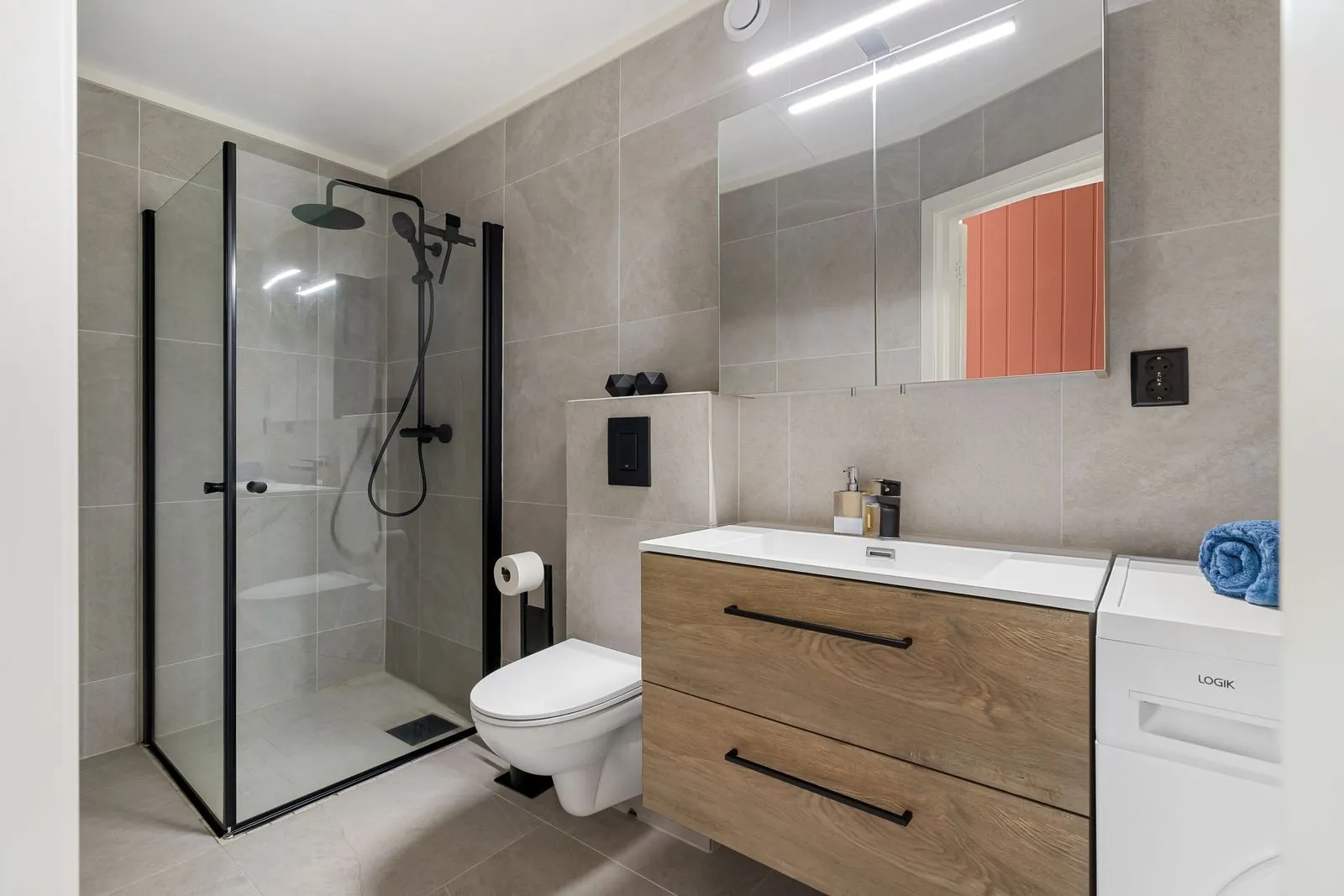
Beyond bars, the frequent requests are a comfort-height toilet in place of a standard one, a handheld shower on a slide bar so someone can wash seated, a shower seat, and non-slip treatment on a slick tub floor.
Stairs, entries and thresholds
Handrails on both sides of a staircase, continuous from top to bottom and with a shape a hand can actually close around, cost very little and matter enormously. A great many houses have a rail on one side only, and it will be the wrong side for someone favoring an arm after a hip replacement.
At entries, the issue is usually a single step or a raised threshold at a door. Threshold ramps solve the small ones. Where a walker or wheelchair needs to get through, transition ramps at interior doorways and removing the raised strip between rooms make a house navigable in a way that is invisible to everyone else.
Lever handles instead of round knobs on every interior door are a five-minute change per door that makes a real difference to arthritic hands.
How the local housing stock affects this
The two-story layouts that dominate the newer subdivisions across Apex and Cary put every bedroom upstairs, which becomes the central problem when stairs get difficult. The usual response is making a first-floor room work as a bedroom and improving whatever half-bath is nearby — adding bars beside the toilet, better lighting, and a clear path from the room to the bathroom without a threshold in it.
Older houses have the opposite profile. The pre-war bungalows across Durham and near downtown Apex are mostly single story, which helps, but they have narrow doorways, high steps at the porch, small bathrooms with no clear wall for a bar, and original doors that stick. Structural widening is contractor work, but swing-clear hinges recover a couple of inches of doorway width for a fraction of the cost and are frequently enough.
Related work often booked at the same time: door and window repair for doors that are hard to operate, and ceiling fan and light fixture installation for stairway and bathroom lighting.
Aging in place modifications — common questions
Can a grab bar go anywhere in the shower?
It has to land where there is something to hold it. A properly fitted bar is anchored into the studs behind the wall, or into heavy-duty toggle anchors rated for the load where a stud is not available. A bar screwed into tile and drywall alone will pull out at the worst possible moment. Positioning is worked out around how the person actually gets in and out, which is why it is best decided with them present.
Can bars be drilled into tile without cracking it?
Yes, with the right bit, low speed and no hammer action. Modern porcelain is hard and needs patience. The other consideration is what is behind the tile — where a shower is a fiberglass surround rather than tile over backer board, blocking or a wall-mounted backing plate spreads the load.
Is a permit needed for a ramp?
A portable threshold ramp at a door is a product, not construction, and needs nothing. A permanent ramp with a landing generally is regulated construction and depends on rise, length and whether it is attached to the house, so the local inspections office is worth a call. Most requests here are for the small threshold type.
What is the highest-value thing to do first?
For most households it is a combination of lighting and stairs rather than the bathroom. Stairs with a handrail on one side only, poorly lit landings, and rugs at the top or bottom account for a large share of falls at home. Those are inexpensive to address and are usually done in a single visit.
Often booked with this